Egg Rolls

A customizable, vegetarian version of this crispy worldwide favorite!

Cooking Summary
Ingredients: (detailed list)
- Main Ingredients: dried shiitake mushroom, vermicelli noodles, cloud ear fungus, cabbage, celery, carrot, snow pea, garlic, egg roll wrapper, oil
- Egg Roll Glue: flour, water
- Filling Seasoning: oil, salt, sugar, Kikkoman® Vegetarian Oyster Sauce, white pepper, Kikkoman® Sesame Oil
Jump To Section
Top 3 Mistakes
- Leaving water in the filling:
Squeeze or drain the filling ingredients as instructed before mixing them in. Extra liquid can loosen the mixture and make the wrappers harder to keep intact during cooking.
- Crowding everything at once:
Cook in manageable batches rather than adding everything at once. Follow the recipe’s batch sizes so you can control the timing and keep the pieces from sticking together.
- Rushing the mushroom soak:
Give the dried mushrooms time to soften before cooking. A quick rinse is not a substitute for rehydration; follow the soaking step so the centers are ready along with the edges.
Overview
Egg Rolls vs Spring Rolls
In the US, the terms egg roll and spring roll are basically used interchangeably, but they’re actually different. The Cantonese name of what we're making is 春捲 ceon1 gyun2, meaning spring rolls, so technically... calling these spring rolls would be more accurate.
But one advantage to calling these deep-fried treats by the name "egg roll" is that we can more easily differentiate from the Vietnamese-style cold appetizer "spring rolls" or "summer rolls", which are the vegetables, herbs, noodles, and shrimp rolled in a rice paper wrap.
The disadvantage to using the name "egg roll" for these 春捲 ceon1 gyun2 is that there's a similar deep-fried appetizer with a thicker, doughier, chewier wrapper that is called egg rolls.
There are versions of this deep-fried treat all over the world; lumpia is another world favorite. With this savory recipe, we’re making the smaller, traditional Cantonese-style roll with thin, crispy skin, so we should call this a spring roll.
Thank you, Kikkoman!
This recipe is brought to you in part by Kikkoman. My dad has been using Kikkoman flavors throughout his 50-year career as a chef, and it's a privilege to get to partner with them on such an iconic recipe, Egg Rolls!
- Kikkoman products are a major flavor enhancer and bring out the “umami” taste, and helps balance and round out flavors
- Kikkoman® Less Sodium Soy Sauce is perfect for home cooks who are looking to cut down on their sodium levels, without sacrificing flavor
- Kikkoman offers wide range of Gluten-Free Asian sauces, including Gluten-Free Oyster Sauce and Gluten-Free Hoisin Sauce
- The KikkomanUSA.com Chinese site offers easy Asian recipes that home cooks can enjoy any night of the week
You can learn more about Kikkoman and follow them on social media here:
- Website: https://www.KikkomanUSA.com
- Facebook: https://www.facebook.com/KikkomanChineseUSA (Kikkoman 萬字在美)
- Instagram: https://www.instagram.com/kikkomanusa_chinese/ (Kikkoman 萬字在美)
Ingredients

Why this recipe
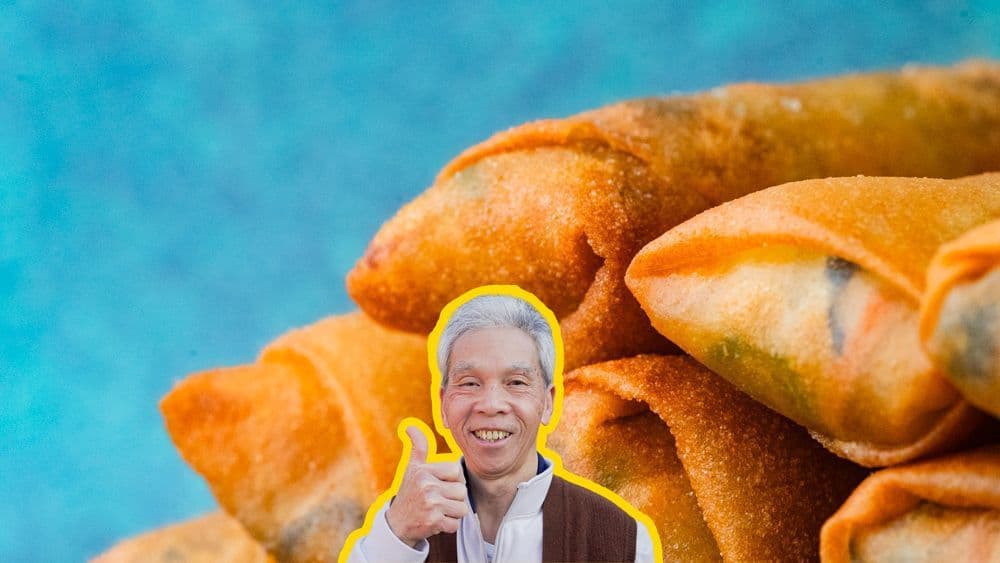
Most egg rolls recipes online are tested only a handful of times. My dad used to make this dish multiple times a day, every day, for 60+ years and can make this in his sleep.
I know you'll love it as much as our community does! This recipe has over 2.2M views, 32.1K likes on YouTube.
What kind of wrapper to use
My dad has used the same brand of wrapper for decades, so if you'd like to use the same as him, get the Wei Chuan Spring Roll Shells.
Otherwise, look for "spring roll wrapper", "egg roll wrapper", or "lumpia wrapper" on the packaging.
The ingredient list should mainly include wheat flour, water, and a bit of oil. To get the result you see in our photos and videos, avoid the wrappers that have egg in them.
If the dough contains egg, it will be thicker, sturdier, and chewier, and when you fry the egg roll, it'll bubble up and blister. Still tasty, of course, but somewhat of a different dish.
Egg roll fillings
Our recipe is for a crunchy vegetarian egg roll, but possibilities are endless!
Other than the vegetables that we've included, you can also add any type of meat. Finely chopped or ground meat will be easiest to wrap, or shredded seafood.
If you'd like to add other vegetables, opt for those that won't release too much water while cooking. Avoid spinach and bok choy, for example.
We really, really recommend including mung bean vermicelli. It contributes a ton to the texture and it helps soak up all the moisture of the filling so the wrapper can stay dry. It's available in the dry noodle section of your local Chinese grocery store, or often in the Asian aisle of your local Western grocery store. If you'd like to buy it online instead, here's an Amazon link.
Other filling options include:
- peppers
- onions
- green onions
- bamboo shoots
- varieties of mushroom
- ground or shredded meat
- seafood
- rice vermicelli (this is softer and less chewy compared to mung bean vermicelli, but will still help soak up juices and water!)
The idea is that everything in the filling should be either shredded into thin strips or minced finely, so they'll mix together easily and so that no shapes will poke out too aggressively when you're trying to wrap the egg roll.
Oil for frying
Since we're deep-frying at a somewhat high heat, make sure you're using a refined cooking oil that's suitable for the temperature (330°F, or 165°C). We use tea seed oil, which is on the healthier side.
After frying, you can save the oil for cooking other dishes. If there are bits of debris (there shouldn't be much for egg rolls), strain them out before storing the oil.
How to make Egg Rolls
Prepare dried ingredients
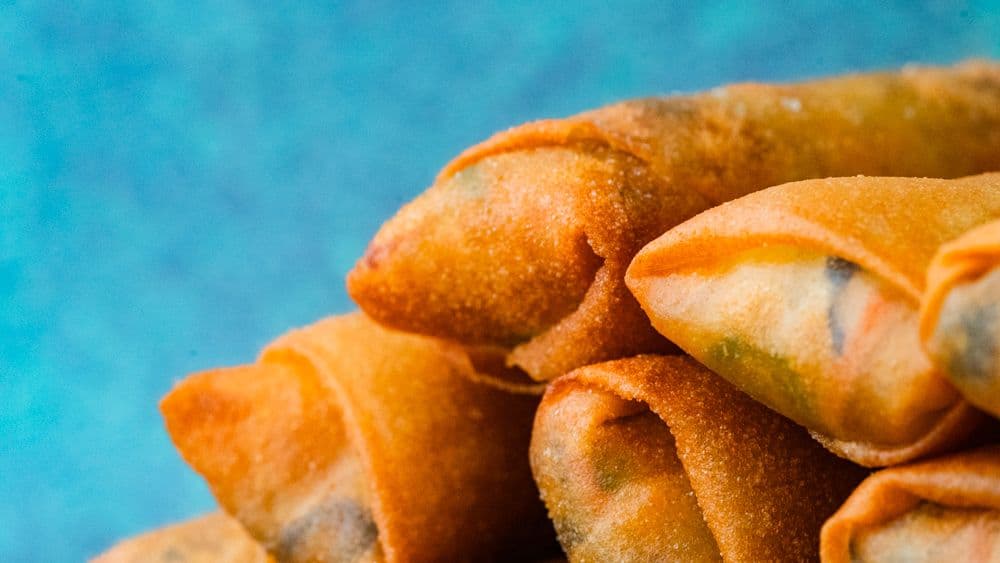
We'll be using a bunch of dried ingredients, so we'll start by rehydrating them all separately.
Soak the vermicelli noodles (2 oz) in warm water to rehydrate. It shouldn't take more than 10 minutes for them to become pliable.
Soak the dried shiitake mushrooms (0.50 oz) in hot water for 10-15 minutes.
Similarly, soak the cloud ear fungus (0.25 oz) in hot water for 10-15 minutes. If you've managed to find fresh ones, skip the rehydrating step.

Cut ingredients
First, prepare the cabbage (8 oz). Cut away and discard the hard stalk in the center, where it's very thick and dense. Stack the leaves and chop into very thin strips.
Cut the rehydrated cloud ear fungus and shiitake mushrooms into very thin strips as well.
Cut the celery (4 oz) into 2-inch segments first, then into thin strips.
Chop the snow peas (1 oz) into thin strips.
Stabilize the carrot (3 oz) for a safer cutting experience by slicing off one side and creating a flat surface for it to lay on. If the carrot is long, cut it into 2-inch segments. Then, cut into thin slices, and then into thin strips.
Smash, peel, and roughly mince the garlic (3 clove).
If you're noticing a pattern here, yes, all of the filling ingredients are going to be very thin strips, like tiny noodles. The finer you slice them, the more flexible they'll be, which will make wrapping them easier. If they're on the thicker side, then they'll be a little pokier.
Don't worry if your strips are not super thin, though, because we'll be stir-frying everything, and that'll help soften them up a little.
Create glue
In a small bowl, mix together flour (2 tbsp) and water (2 tbsp). Set it aside for later.
Stir-fry filling
Heat your wok on high heat until it's hot, or about a minute.
Add oil (1 tbsp) and give it a swirl to coat the wok. Let it heat up for 30-40 seconds.
Add garlic, and fry it until it's aromatic.
Add the shiitake mushrooms, and cook for 20-30 seconds.
As you add each additional ingredient, mix them in thoroughly as they cook.
Add the celery and the cabbage. Cook for 30 seconds.
Add the carrot and cloud ear fungus. Cook for 30-40 seconds.
Use scissors or kitchen shears to cut the vermicelli a few times. The shorter segments will be easier to cook, combine, and wrap later. We'll add them at the end.
Season the filling with salt (1 tsp), sugar (1 tsp), white pepper (0.25 tsp), and oyster sauce (1 tbsp). We used the vegetarian version because we happened to have it at home, but you can use regular oyster sauce instead.
Mix the seasoning in well to distribute, and then add the snow peas.
Finally, push all the ingredients to the sides of the wok to make a small hole in the center. Add the cut-up vermicelli to that hole. All the juices and moisture that the vegetables have released will flow down to the center, and the vermicelli will (very helpfully and deliciously!) soak it all up. Mix the vermicelli in the center to give it a good head start on soaking up the moisture, and then mix it in with the rest of the filling.
Add sesame oil (1 tbsp) and stir-fry for another 30-40 seconds, making sure everything is well-combined.
Turn off the heat and plate the filling to help it cool down for the wrapping step.
Wrap rolls
The wrappers are usually slightly stuck together. You'll want to peel each individual wrapper off and create a loose stack. Do this for the number of egg rolls you're making. Quickly put the rest back in the packaging so they don't dry out.
You also don't want the ones you're using for this session to dry out, so gently put your stack of wrappers in a plastic bag or container. Take one wrapper out when you're ready to wrap it, and leave the rest covered.
Lay the wrapper with a corner pointing at you, like a diamond. Put 2 tbsp of filling in the wrapper, between the middle and the corner that's pointing to you. (After wrapping a few, you'll find a sweet spot. Just like pancakes, the first one is always the ugliest!)
From here, the process is pretty similar to wrapping a tiny burrito.
Bring the wrapper corner that's closest to you and wrap it up and over the mound of filling, then tuck the tip under and firmly pull the covered section back towards yourself to tighten. Keep enough pressure on it to press out air pockets and keep the filling together, but be gentle as to not rip the wrapper.
Keep the pressure pushing on the filling as you roll towards the middle. Be sure not to let the filling spread out too far horizontally, or your roll will be long and thin like a pencil.
At the halfway point, make a crease where the filling ends on the left, and fold that side of the wrapper up and over. Do the same crease and fold with the right.
Dab some of the flour-and-water glue on the top corner of the wrapper. As always, keep firm pressure on the roll as you roll it up to the end. The glue will seal the end of the roll.
Repeat with the rest of the filling and wrappers until all your egg rolls have been wrapped up.
(Stack the completed rolls with the sealed corner down, so that gravity can help keep them tightly sealed.)
Deep-fry rolls
Heat oil (16 oz) in a deep pot over high heat. Let the oil reach 330°F (165°C), then turn the heat to low.
Add the egg rolls in batches of 6 as to not overcrowd the pot. As they cook, move them around and flip them so they fry evenly.
Fry on low heat for about a minute and a half, then turn the heat to high.
Similar to the double-fry method when we make Orange Chicken and Salt & Pepper Pork, the first stage of cooking at lower heat does more to cook the entire piece through, while the second stage of cooking at higher heat is meant to make the exterior crispy and crunchy. This time, though, there's no need to pull the food out and put it back in; we'll just up the heat while everything is in the pot.
Fry at high heat for a minute and a half, until they're golden brown and crispy. Remove the cooked egg rolls from the oil. My dad likes to use a spider strainer and let the excess oil drip back into the pot for a few seconds.
The residual heat from the oil will continue to cook the wrapper, so expect the golden brown to deepen a tad even after pulling them out of the pot.
Plate the cooked egg rolls. Remember to lower the heat when you start the next batch.
Enjoy quickly for maximum crunch! (but also, super freshly fried food is maximum yeet hay, so do let them cool down for a bit before serving.)
Pairs well with
View all →
Made with love ❤️
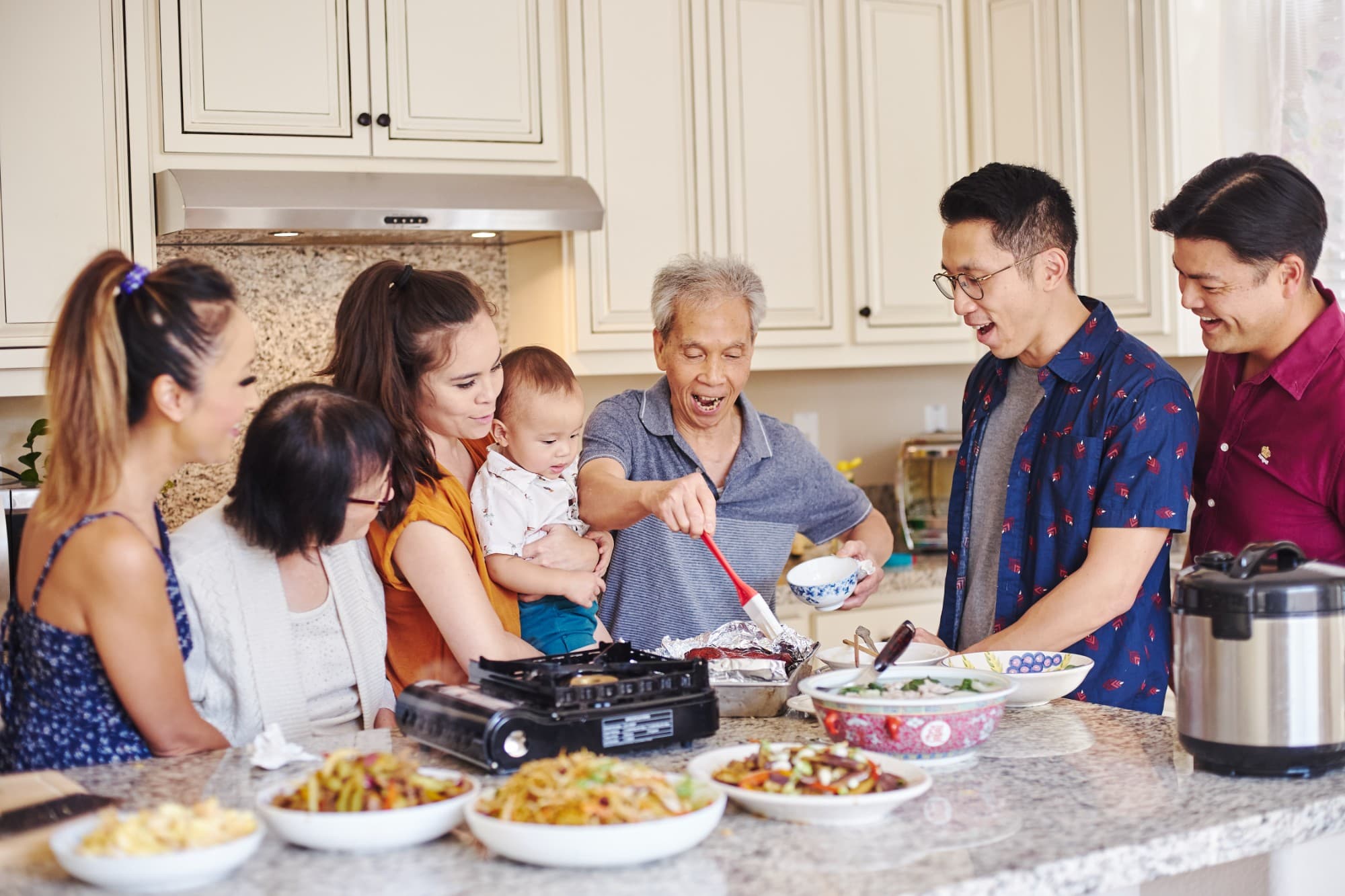
We started Made With Lau to celebrate Cantonese culture and honor the legacy of our wonderful parents, Jenny and Chung Sun Lau.
Our hope is that these recipes and stories help you spread the joy, love, and nostalgia that I felt growing up.
