
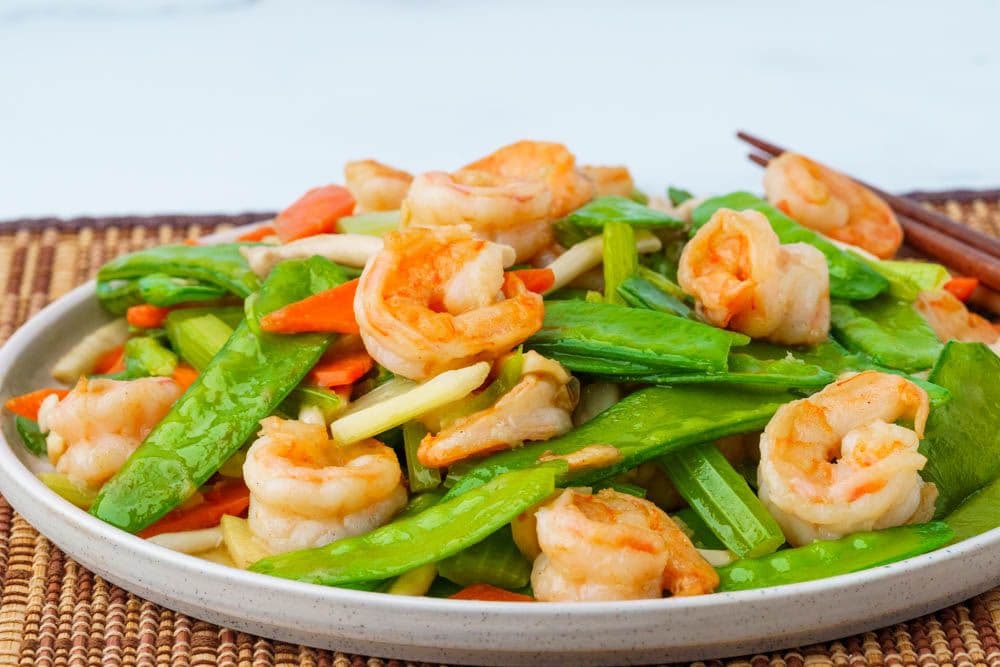
The Shrimp & Snow Pea Stir Fry My Dad's Made 100,000 Times

Why this recipe

Most shrimp & snow pea stir fry recipes online are tested only a handful of times. My dad used to make this dish multiple times a day, every day, for 60+ years and can make this in his sleep.
I know you'll love it as much as our community does! This recipe has over 331K views, 6.5K likes on YouTube.
This dish makes frequent (and welcome!) appearences at weeknight dinners. It comes together quickly, but the recipe makes no sacrifices in flavor or texture. The tender shrimp and crunchy snow peas, and the various textures and colors of the carrots, celery, and mushrooms, are a complete delight to eat.
Although you'll be whipping together a quick sauce for this stir-fry, you'll notice that the sauce ingredients are not very overpowering in flavor or amount. They're really just there for the assist. This is a stir-fry in the truly classic Cantonese style of highlighting the natural flavor of the main ingredients.
Pairs well with
View all →
Ingredients

Sustainable sources of shrimp
If you’re looking to buy sustainably sourced shrimp, Monterey Bay Aquarium’s Seafood Watch recommends that you avoid shrimp from places like Argentina, China, India.
If you do end up buying shrimp from those areas, it's totally fine (my parents do), but Seafood Watch notes that the shrimp are sourced with less sustainable methods.
To learn more, check out the link at Seafood Watch.
Snow peas in Chinese cuisine
In Cantonese, snow peas are called 荷蘭豆 ho laan dau or "Holland Peas". It's said that the Dutch introduced them to Taiwan and modern-day Indonesia in the 17th century. Even though snow peas are actually native to the Mediterranean region, the name stuck and as snow peas spread around and grew in popularity, they became a staple in Chinese cuisine.
Instructions
Prepare shrimp
Peel the shrimp (10 oz). Start by pulling off the third segment from the tail. Then, it'll be easy to pull off the back and the tail completely. To peel the rest, hook your finger under the segment next to what you just removed, and pull the shell away. It should come off quite cleanly!
Of course, if your shrimp is pre-peeled, you can skip to de-veining and marinating.
Slice into shrimp near the head and cut nearly all the way down the center of the shrimp's back to the tail. This cut will make larger shrimp cook more evenly. Remove the vein, either by hand (a paper towel makes it super easy) or by picking it out with your knife.
If your shrimp is small and doesn't require the cut along the back, then pick out the vein with a toothpick. Jab the toothpick in under the vein, and pull it straight out.
Marinate shrimp
Mix the shrimp in a bowl with white pepper (0.25 tsp) and salt (0.50 tsp). When the seasonings have been thoroughly mixed into the shrimp, mix in cornstarch (0.50 tsp). The cornstarch helps keep the shrimp tender.

Prepare veggies
String the snow peas (10 oz). Both sides of the snow peas have a tough fiber, so remember to do both sides.
Pinch one of the tips and break off one side (or make a tiny cut there with a paring knife), so the tip is dangling, and then pull it along the attached side to pull the string out. It's a very satisfying pull, like undoing a seam. Repeat on the other side. Do this for all the snow peas.
Wash any dirt and debris off the stringed snow peas by soaking in water for 5-10 minutes. Then, drain the water and let them dry.
Cut celery (4 oz) lengthwise in half or into thirds, and then into 1-inch strips.
Cut the carrot into diamonds. First, cut at an angle into 1/2-inch pieces. Then, lay them with a cut side down and slice them into 1/8-inch thick slices. Ta-da, diamonds!
Prepare aromatics
Cut the green onions (2 stalk) at an angle into inch-long pieces.
Cut the ginger (1 oz) into slices, and then small pieces. Don't mince finely here, as that would be more likely to burn in the oil later.
Smash the garlic (2 cloves) with the flat side of your knife. Then, peel and mince them.
Remove the ends of seafood mushrooms (1 pack) with a quick cut.
Create sauce
In a small bowl, mix together salt (0.50 tsp), sugar (1 tsp), cornstarch (1 tsp), cooking wine (1 tbsp), white pepper (0.50 tsp), fish sauce (1 tsp), and water (1.5 tbsp).
This will be the delicious sauce for the stir-fry! Mixing it together now will make the quick stir-fry process go so, so smoothly.
Blanch vegetables
Pour boiling water (10 oz) into a wok and set it to high heat. Add salt (1 tsp) and oil (1 tsp). If the water cools down, wait until it comes back to a boil before starting to blanch the vegetables.
Take advantage of the time it takes for each different vegetable to blanch, and add them in this order:
- First, celery and carrot, then wait 30-40 seconds
- Next, snow peas, then wait 30 seconds
- Finally, seafood mushrooms.
Once everything is blanched but still brightly colored, drain the water out by pouring it all into a colander. Keep the blanched vegetables handy for stir-frying in just a minute.
Stir-fry shrimp
You can either give the wok that you blanched the vegetables in a quick wipe, or grab a new wok. Heat it on high for 40-50 seconds, then add oil (1 tbsp).
Let the oil heat up for 15-20 seconds, then stir-fry the shrimp for 40-50 seconds, making sure to flip and toss them for even cooking. When they turn white, quickly transfer to a plate. You definitely don't want them to overcook and become tough and rubbery.
Stir-fry everything
Time to put it all together. There should still be plenty of oil left in the wok, so use that to stir-fry everything in this order, starting with the aromatics:
- Add the ginger and garlic in, and stir-fry for 5 seconds
- Add the green onion, and stir-fry for 10 seconds
- Add the blanched vegetables, stir-fry for 5 seconds
- Add the shrimp, and stir-fry for 10 seconds
- Season with cooking wine (1 dash), and stir-fry for 10 seconds.
- Mix the sauce in case it has settled and separated, then pour it in, and stir-fry for 12-15 seconds
Turn off the heat, and drizzle a bit of sesame oil (1 dash) over everything. Remember it's pretty strong, so don't add too much!
Mix everything together for another 10 seconds, and plate. Enjoy!
Made with love ❤️
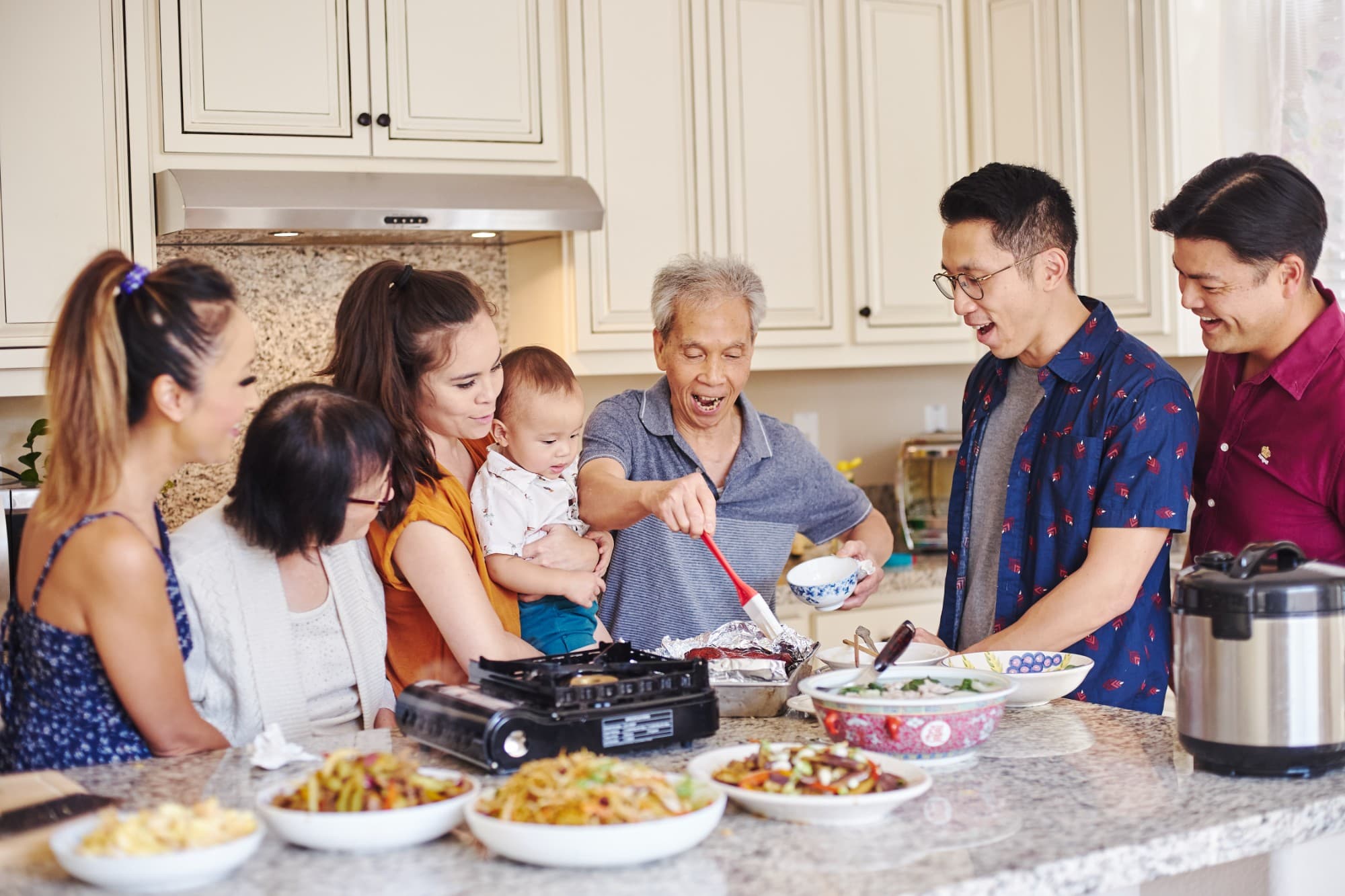
We started Made With Lau to celebrate Cantonese culture and honor the legacy of our wonderful parents, Jenny and Chung Sun Lau.
Our hope is that these recipes and stories help you spread the joy, love, and nostalgia that I felt growing up.
