
The Honey Walnut Shrimp My Dad's Made 100,000 Times

Why this recipe

Most honey walnut shrimp recipes online are tested only a handful of times. My dad used to make this dish multiple times a day, every day, for 60+ years and can make this in his sleep.
I know you'll love it as much as our community does! This recipe has over 823.4K views, 19.3K likes on YouTube.
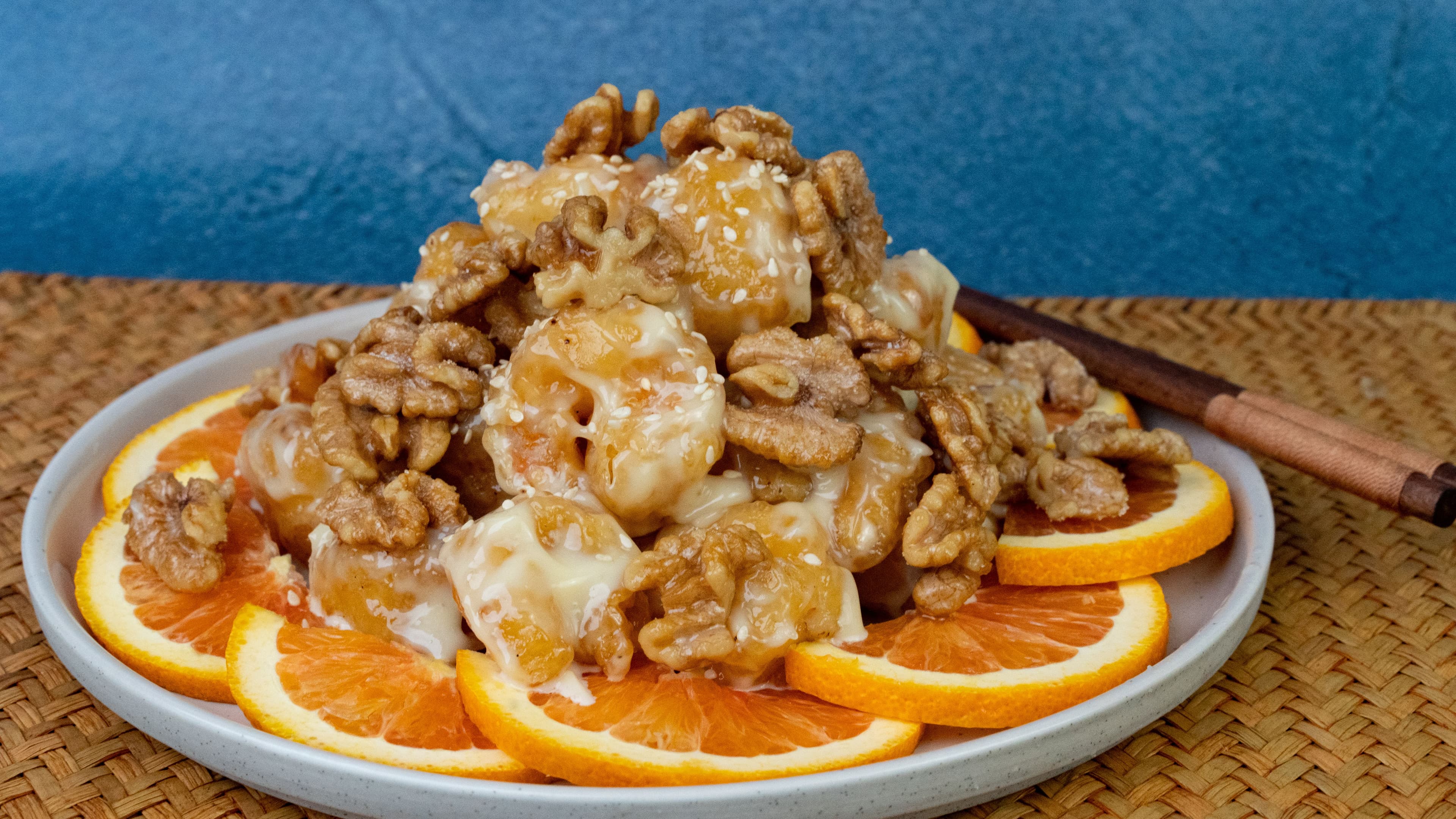
If you’ve never tried honey walnut shrimp before, it’s like the perfect balance of sweet, savory, crunchy, creaminess.
The Origins of Honey Walnut Shrimp
For our video, we got a lot of questions about the origins of honey walnut shrimp. It’s interesting because it doesn’t taste like old school Chinese cuisine, and also, just like General Tso’s Chicken, it’s extremely popular in the West yet fairly unheard of in the East.
I couldn’t find anything definitive on the exact origins, but most likely, the dish was first invented in Hong Kong, and made its way to the US in the 80s and 90s.
Interestingly, none of my younger friends in Hong Kong have even heard of this dish. BUT, digging deeper, when we asked the older generations of Hong Kong, they had tons of memories and experiences eating it.
By one anecdote from my friend’s mom, growing up in Hong Kong in the 60s and 70s, she went to banquets all the time. Both walnuts and prawns were considered expensive and celebratory, but the walnut prawn dish was a more affordable seafood banquet item compared to dishes like abalone or steamed grouper.
Fast forward to today, at least in the US, it’s extremely popular as both a Chinese banquet and takeout dish. It’s one of those rare recipes that’s guaranteed to wow your friends but is also extremely easy to make.
Chinese Symbolism of Walnuts & Shrimp
As with many other Chinese dishes and ingredients, shrimp and walnuts both carry positive omens when served at big events and holidays.
The Cantonese word for "shrimp (虾 hā)" resembles the words for "laughing out loud (哈哈笑 hā hā siu)", so it's a symbol of having a lively time filled with laughter.
Similarly, the Cantonese word for "walnut (合桃 hahp tòuh)" is composed in part by the word "together (合 hahp)", so it's related to the phrase, "百年好合 baak nìhn hóu hahp". This is a common wish for newlyweds to have 100 great years of marriage.
Pairs well with
View all →
Ingredients

On Buying Shrimp
It's easiest to buy shrimp that are already peeled and deveined. My dad likes shrimp that are 26/30 in size, and prefers shrimp from South America.
This isn’t always an option, but if you’re looking to buy sustainably sourced shrimp, Monterey Bay Aquarium’s Seafood Watch recommends that you avoid shrimp from places like Argentina, China, India.
If you do end up buying shrimp from those areas, it's totally fine (my parents do), but Seafood Watch notes that the shrimp are sourced with less sustainable methods.
To learn more, check out the link:
https://www.seafoodwatch.org/recommendations/search?query=%3Afree%3Bshrimp%7Cspecies
On Oils & Smoke Points
You should generally avoid olive oil for anything that involves higher heat.
This is because olive oil has what’s called a lower smoke point, which is the temperature at which the oil stops shimmering or rippling and starts smoking.
Smoking oil isn’t always a problem and sometimes even desired for getting that perfect “Wok Hei” in your stir fry, but it’s a sign that the oil is breaking down, which can release burnt or bitter flavors or even harmful free radicals.
Here’s a chart that highlights the smoke points of a few of the most common cooking oils.
There are a few other factors that go into selecting oils like whether they’re neutral or flavored, refined or unrefined.
Most cooking oil is created by extracting and compressing seeds and nuts, and oils that are “unrefined”, “raw”, or “virgin” are usually bottled almost immediately. They generally have more nutrients but a lower smoke point and shorter shelf life. Refined oils go through more processing for a higher smoke point, longer shelf life, and a more neutral flavor.
It’s not totally true that you should avoid olive oil, since you can buy either refined or unrefined varieties. But for simplicity’s sake, for frying, you generally want to use neutral, refined oils like vegetable oil, refined olive oil, or corn oil.
Finding Asian Ingredients
Some of these ingredients are hard to find in a typical grocery store.
If you don't live near an Asian market, most or all of what my dad uses in this recipe can be found on Amazon:
- Sweetened Condensed Milk - https://amzn.to/3uJdR0u
I've also included some other Chinese kitchen essentials, used in many of my dad's other recipes.
- Kadoya Sesame Oil - https://amzn.to/3c7EOTu
- Pearl River Bridge Superior Light Soy Sauce
- Pearl River Bridge Superior Dark Soy Sauce
- Lee Kum Kee Premium Oyster Sauce
- Shaoxing Cooking Wine
- Koon Chun Ground Bean Sauce
- Dried Shiitake Mushrooms (soak for 15-20 minutes in warm water before slicing)
- Michiu Rice Cooking Wine
- Lao Gan Ma Chili Oil
- Koon Chun Hoisin Sauce
- Bullhead Shacha (BBQ Sauce)
- Dried Orange Peels
- Dried Wood Ear Fungus (a few options, depending on what's in stock):
These links are affiliate links, which means that if you use our links to purchase these ingredients, Amazon pays my family a small amount for the sale - at no extra cost to you. If you use these links, we really appreciate the support!
Other Supplies + Tools
You'll need a good wok, which provides a ton of versatility for the classic Chinese cooking methods: steaming, stir frying, deep frying, and etc.
You may want an instant read thermometer to help you get precise with how you're deep frying. Here are two great options:
Instructions
Prepare shrimp
Assuming you're starting with peeled, deveined shrimp (20 piece) (which is what my dad recommends), cut each shrimp in half lengthwise. This will help result in a more beautiful, crunchy fry.
In a bowl, mix salt (0.25 tsp) with the shrimp.

Prepare sauce
In a bowl, we'll mix mayonnaise (4 tbsp), sweetened condensed milk (3 tbsp), and lemon juice (2 tsp).
Fun fact: During the American Civil War, condensed milk was one of the best field rations for soldiers, since it was so compact and rich in calories. After the war, condensed milk skyrocketed in popularity and became a mainstream product
Prepare batter
In a bowl, we'll beat our egg(s).
In another bowl, we'll mix all purpose flour (4 tbsp), cornstarch (2 tbsp), baking powder (2 tsp), corn oil (2 tsp), water (7 tbsp), and the portion of eggs that we need.
We'll mix until the consistency is smooth. You may need to add dashes of water to get it to the consistency that you want, which is like a thin pancake batter.
Prepare sugar syrup (optional)
If you don't have honey, or don't want to use honey for whatever reason, you can go with the restaurant route.
Add sugar (3 tbsp) and water (2 tbsp) to a bowl and stir. Then, we'll be microwaving it several times:
- 60 seconds
- 30 seconds
- 30 seconds
Between each round of microwaving, we'll be stirring the sugar.
Once we're done and the sugar has cooled and hardened into a syrup consistency, we're done.
My dad said restaurants make large batches of this in a wok (since honey is generally more expensive.)
Heat oil, fry walnuts
We'll fill a pan or wok with enough oil to submerge the walnuts, and heat it to around 300° F (148° C).
Then, we'll fry our walnuts (3 oz) twice, once to cook them, a second time to make them crunchier.
- #1 - Fry for 3-4 minutes. Scoop the walnuts out with a strainer ladle, and let the oil reheat to 300° F (148° C).
- #2 - Mix the walnuts with the honey (2 tbsp) (or sugar syrup). Fry for about 2 minutes. Scoop out the walnuts.
If you can, you'll want to monitor the temperature of the oil. We don't want to let the walnuts cook in oil that's too hot, otherwise they'll burn.
Heat oil, fry shrimp
Read before you start frying shrimp
Ideally, for frying the shrimp, you'll want to use another pan or wok, or clean the pan/wok you were using before frying.
If you stick with the same container, there will be some charred honey/sugar at the bottom, which will stick onto the shrimp and result in a more muddied look after frying.
If you're using a second pan/wok, carefully pour some of the oil from the first pan/wok into the second one, being sure not to let any of the honey/sugar pour in.
How to tell if the oil is hot enough
When you drop the batter into the oil, if it floats immediately, then the oil is hot enough. If the batter instantly turns golden brown, the oil is actually too hot.
Another way to monitor the temperature is with an instant-read thermometer. If you don’t have one, here are two great options:
Start frying shrimp, #1 (cooking)
- While we wait for the oil to heat to 350° F (176° C), we'll mix the batter well. Then, we'll mix the shrimp with the batter.
- Once the oil is hot enough, one by one, carefully set the shrimp into the wok.
- Let the shrimp fry for about 2-3 minutes, until the batter turns a beautiful golden brown.
- Depending on the amount of shrimp you have, you can start transferring out the shrimp that went in first, as the later ones continue to cook.
Start frying shrimp, #2 (crunch)
- This time, the oil should be hotter, around 375-400°F (190-204° C).
- Once the oil is hot enough, we'll carefully transfer the shrimp into the oil.
- Let the shrimp cook for about 60-90 seconds, and transfer them out of the wok into a bowl
Plate and garnish
Mix and coat the shrimp with the sauce from earlier, and add the candied walnuts and sesame seeds.
Call the family over! Time to eat :)
Saving the crunch
It's best to eat this immediately or ASAP.
If you're preparing this as a part of a larger, multi-course meal, you'll want to mix in the sauce right before you're about to eat. Over time, the sauce will seep into the crunchy batter, which will reduce some of the amazing crunchiness.
Made with love ❤️
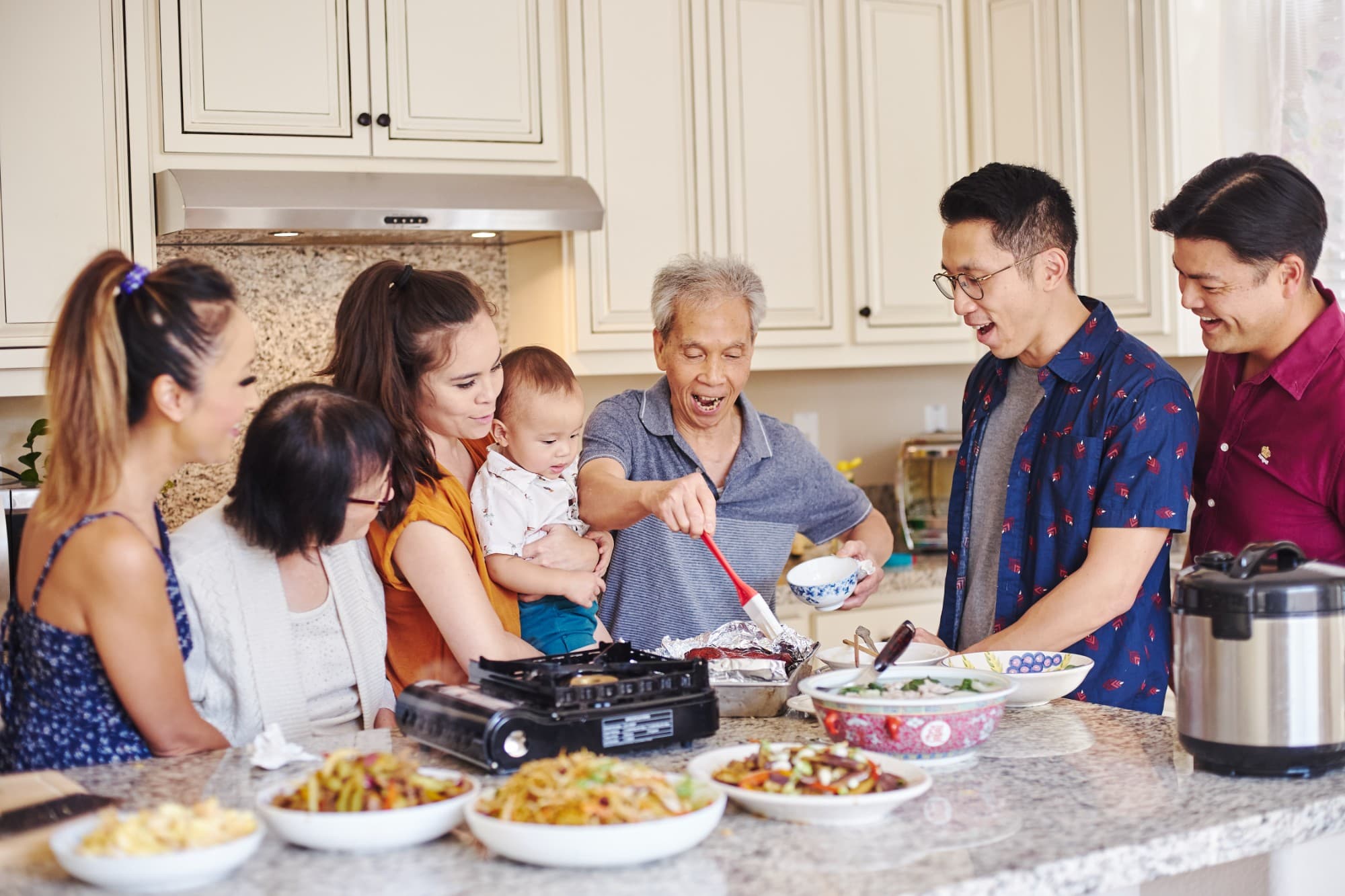
We started Made With Lau to celebrate Cantonese culture and honor the legacy of our wonderful parents, Jenny and Chung Sun Lau.
Our hope is that these recipes and stories help you spread the joy, love, and nostalgia that I felt growing up.
