
The Choy Sum with Garlic My Dad's Made 100,000 Times

Why this recipe

Most choy sum with garlic recipes online are tested only a handful of times. My dad used to make this dish multiple times a day, every day, for 60+ years and can make this in his sleep.
I know you'll love it as much as our community does! This recipe has over 331.3K views, 5.7K likes on YouTube.
Quick, simple recipes like this are the ultimate unsung heroes of Chinese home cooking!
Stir-fried choy sum is delicious, it's nutritious, and it comes together in a flash. The quick cooking time means that yes, you can throw it onto the dinner table in just a few minutes, but it also means that your greens stay bright, tender, and sweet.
Pairs well with
View all →
Ingredients

What is choy sum?
This beautifully leafy green is available at all Chinese supermarkets year-round, and if you have a local Asian community, you might find it at your local farmer's market too. Sometimes, it's alternatively labeled 油菜 "yu choy".
The flavor is sweet and delicate, and the texture is similar to bok choy, lighter than other heartier vegetables.
Its appearance is a bit similar to gai lan. How do you differentiate between them? Choy sum is a lighter, brighter green compared to gai lan's dark, almost blue-green leaves.
The stems are quite different as well; choy sum stems are curved and rather flexible, while gai lan stems are round and dense, like broccoli.
No blanching?
Stir-fries that involve heartier vegetables often call for blanching as a pre-cooking stage. Blanching a hearty vegetable ensures that it's tender enough for a pleasant eating experience.
Choy sum, however, is tender enough to stir-fry straight from raw (after washing and trimming, of course). In Cantonese cooking, this is called 生炒 (saang1 caau2). No pre-cooking necessary!
Instructions
Cut choy sum
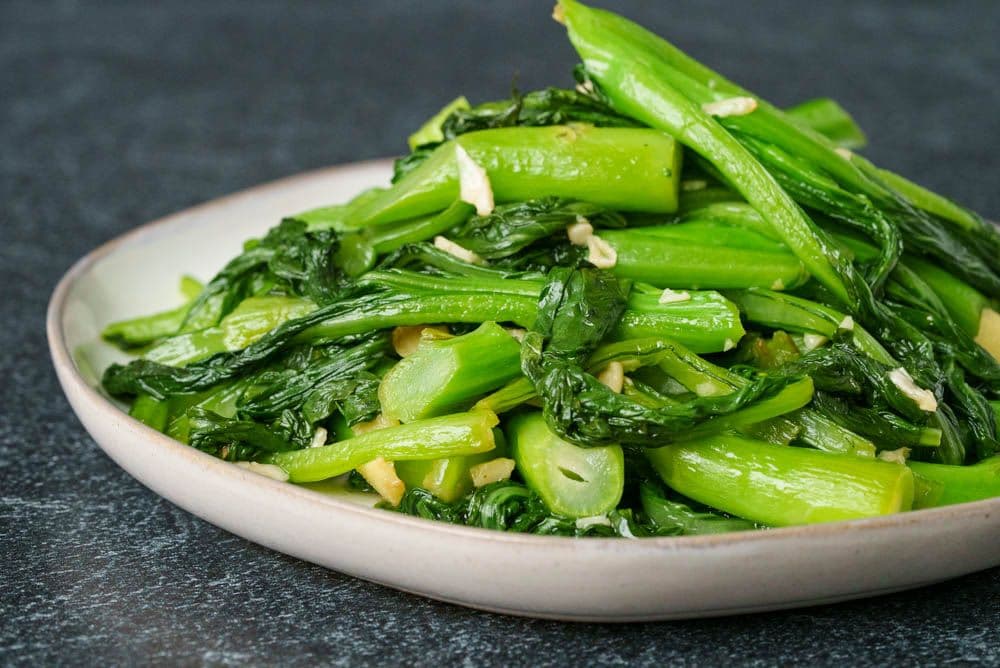
To prepare the choy sum (1 lb), you want to separate the quick-to-cook leaves and the slower-to-cook stems.
You can either make one horizontal chop to separate the leaves and stems of each plant all at once, or you can cut apart the stems (at an angle for extra style points) and then chop away the leaves to separate.

Prepare aromatics
Slice the garlic. For maximum visual appeal, leave some of them sliced (2 cloves) and mince the rest (3 cloves).
Cut the ginger ( small amount) into roughly 1/8 slices. In our video, we used about 4 slices of ginger for 1 lb of choy sum.
Stir-fry aromatics
Heat your wok over high heat for a quick minute. Add a dash of oil (1 tbsp), then turn the heat to medium low. Lowering the heat here is important to avoid burning the aromatics.
Add the ginger and garlic. Stir-fry for 15 seconds so that you can smell the ginger and garlic releasing their aromas.
Stir-fry choy sum
Add the stems first, since they'll take longer to cook through. Stir-fry the stems for about 30 seconds.
Then, add the leaves.
Raise the heat to high and add cooking wine (1 tsp) and sugar (1 tsp) to balance the texture of the leaves; these ingredients help make the dish silky smooth. Mix the seasonings in and stir-fry for another 30 seconds.
DON'T ADD THE SALT YET! If you add salt now, all the water in the vegetables will release (thank you, osmosis) and you'll end up with less tender vegetables in a puddle of juice.
Cover with lid & final seasoning
Lower the heat to medium or low heat. Cover with the lid and let it steam for about 1.5-2 minutes, or until the choy sum is tender and just cooked through.
Uncover the wok and bring the heat up to the highest setting. Stir-fry on high heat for a minute, then add salt (0.50 tsp).
Drizzle finishing oil (1 tbsp) over the top for a smooth texture, a glossy look, and to help preserve that vibrant green color.
Toss the finishing oil in for another 20 seconds, and then plate. Enjoy!
Made with love ❤️

We started Made With Lau to celebrate Cantonese culture and honor the legacy of our wonderful parents, Jenny and Chung Sun Lau.
Our hope is that these recipes and stories help you spread the joy, love, and nostalgia that I felt growing up.
